



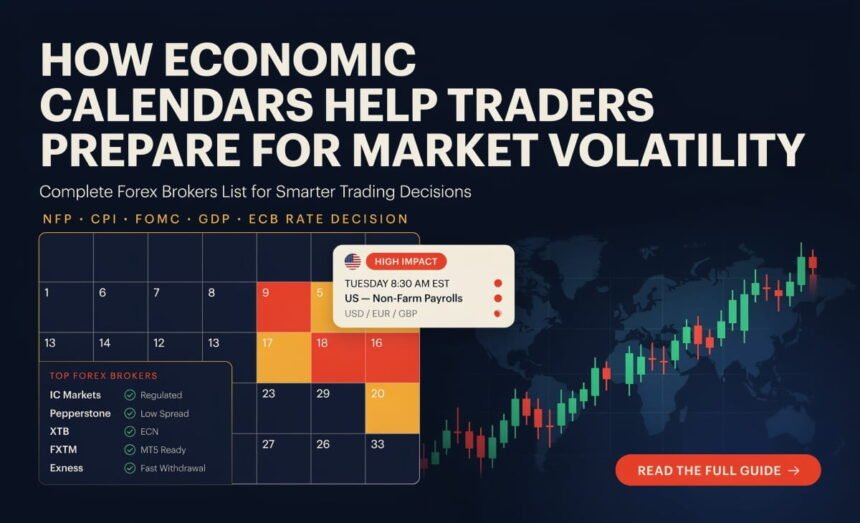
Most prepared traders know that market volatility rarely appears out of nowhere: it’s scheduled. This is why it’s important to ensure that your entire forex strategy is built into the weekly use of an economic calendar. Without using one, you’re trading blindly in markets that have full visibility.
Every major move in the forex market has a date stamp. Central bank decisions, job and employment reports, and inflation data. None of these factors arrives unannounced; these things occur at regular intervals, and using an economic calendar ensures that you’re fully aware of what’s around the corner. The traders who get hurt during market volatility are the ones who missed the calendar, not the ones who missed the markets’ movements.
Let’s get into what that calendar is showing you, how to read it, and the best ways to build a strong routine to account for well-known periods of volatility.
The economic calendar is an intelligence tool, not a diary
An economic calendar is a scheduled list of important financial data releases and events. The calendar usually tags each item with three things: the date and time of the release, the impact rating (usually color-coded for low, medium, or high) of the information, and the forecast figure (a consensus estimate based on economist projections). These three factors mean that the calendar is less a diary and more an intelligence tool.
When the actual figure released differs from the expectations of the consensus forecast, the market can move very sharply. For example, a higher-than-expected Consumer Price Index (CPI) print signals stronger inflation. This may then prompt the Federal Open Market Committee (FOMC), commonly referred to as the Fed, to raise rates to strengthen the dollar.
Nowhere is this more apparent than in the data the FOMC watches closely, including Non-Farm Payrolls (NFP). This monthly US jobs report is released by the Bureau of Labor Statistics and consistently ranks among the most market-moving releases on the forex calendar. The chain of cause and effect here is what all traders must prepare for. Put simply: the calendar shows you the forecast, the market reacts to the gap.
Get ahead of the curve by understanding the lead-up to Fed announcements
Most forex traders watch the Fed announcement itself, but often disregard the lead-up to it and how the market is unfolding based on those economic projections. Understanding how key economic indicators interact with market expectations is the foundation of reading any economic calendar effectively. The economic calendar maps the full Fed cycle: not only the rate decision, but the speeches, minutes, and preparatory data releases that precede it. That distinction matters.
Instead of treating the Fed rate decision like a starting pistol, you should react instead to everything the calendar tells you is already coming. Most big players, whether institutional traders or hedge funds, have positioned themselves weeks in advance, using an economic calendar to cover all the bases appropriately.
A good calendar will show you dates and times of individual FOMC members speaking publicly about their outlook, indicating which way they are likely to vote. You’ll also know when minutes from the previous FOMC meeting are released, detailing any internal debates had by the Fed. CPI, NFP, and other releases that the Fed explicitly uses to inform its decision are also listed on your calendar, ahead of the date of the rate decision itself. At this point, the market has largely already been priced into the outcome.
Plan your weekly trades as part of a Sunday ritual, using the economic calendar
A good trader doesn’t solely understand their economic calendar; they use it systematically to ensure they are always positioned strongly ahead of potential volatility. Most prepared traders have a Sunday ritual. They build the habit of designing their week’s moves around what the economic calendar indicates is forthcoming.
Most economic calendars color-code their events by impact level. High-impact events, or red flags, are non-negotiables: FOMC rate decisions, NFP, CPI, and GDP releases. These carry the highest probability of sharp, dramatic market movement. Prepared traders are never caught off guard by them.
Medium-impact events, or orange flags, such as housing data or the ISM Manufacturing PMI, are worth taking into consideration if you are holding positions during their release windows. Low-impact events, or yellow flags, are generally safe to trade around, but you should always take a glance at them to check whether they feed into a broader narrative.
The most dangerous moment in forex trading isn’t a volatile market: it’s a quiet calendar that breeds complacency. Ahead of any high-impact event, it is standard practice among prepared traders to revisit their position sizing. How you manage that exposure to risk depends entirely on your strategy, as well as the tools your broker gives you access to. Your choice of broker and their tools is where preparation either holds or falls apart.
Preparing well also means selecting the right broker with the right tools
Unfortunately, not all brokers surface calendar data equally. Choosing the right broker is, in itself, the first act of preparation. The information your platform highlights before a high-impact event matters almost as much as anything you do with it.
TopBrokers exists to provide detailed overviews of every major broker on the market. Providing a comprehensive forex brokers list allows you to assess the pros and cons of each one, making it far easier to find the perfect platform for your trading strategy.
The right broker does more than execute your trades: it equips you to make the best decisions possible before you ever place one. If your current platform isn’t giving you access to tools that supercharge your strategy, a good forex brokers list is the most practical place to start.
Volatility is always scheduled, so be ready
No calendar can tell you which way the market will move, only that it is about to. Volatility is still scheduled. That much hasn’t changed at all. What does change is whether you are ready for it. Every major move in the forex market still has a date stamp: the only question left is whether yours does too. That is why using an economic calendar should be a firm part of your forex trading routine.
If you’re concerned that your current platform isn’t offering you as much information as we’ve outlined here, you’d do better to switch to a broker that will support these critical needs for its traders. The TopBrokers forex brokers list is regularly updated to reflect the features of each platform and the popularity among traders. The calendar was always there. Now, so is your plan.