



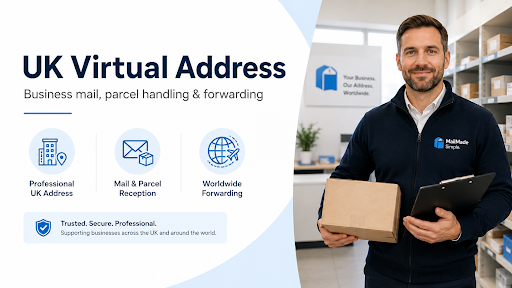
Launching a startup or running an online business often means working remotely, managing costs carefully and avoiding unnecessary commercial rent. However, every business still needs a reliable address for receiving correspondence, parcels, supplier deliveries and customer returns.
A UK virtual address gives businesses access to a professional address without requiring them to rent a traditional office or warehouse. Depending on the service selected, it may also include mail handling, parcel reception, forwarding, storage and ecommerce returns management.
For entrepreneurs working from home, overseas sellers entering the UK market and growing ecommerce brands, a virtual address can provide a flexible way to establish a professional business presence while keeping operating costs under control.
This guide explains how UK virtual-address services work, who can benefit from them and what to consider before choosing a provider.
What Is a UK Virtual Address?
A UK virtual address is a genuine physical address that a business can use for approved commercial purposes without occupying the premises as a conventional tenant.
The provider receives items on behalf of the business and processes them according to the selected plan. Services can vary considerably, but they may include:
- Business mail reception
- Parcel acceptance
- Customer returns handling
- Mail and parcel forwarding
- Temporary storage
- Parcel consolidation
- Supplier delivery reception
- Ecommerce fulfilment and dispatch
A virtual address does not usually provide the business with a private office or unrestricted access to the premises. Instead, the customer pays for the right to use the address and receive associated handling services.
It is important to check exactly how the address can be used. Some providers offer a correspondence address only, while others support parcels, company mail, customer returns or business registration services.
Why Startups Use a UK Virtual Address
Starting a business can involve substantial costs. Website development, stock, marketing, software, insurance and delivery expenses can quickly consume a limited startup budget.
Renting commercial premises may not be necessary during the early stages, especially when the business can be operated remotely.
A UK virtual address allows startups to access a professional location while avoiding many of the costs associated with a traditional office or warehouse.
Protecting a Residential Address
Many entrepreneurs initially operate from home. Although this keeps expenses low, they may not want to display their residential address publicly on websites, invoices or customer communications.
A virtual business address can help create separation between personal and commercial activities.
This can be particularly useful for:
- Freelancers
- Consultants
- Online retailers
- Home-based service providers
- Marketplace sellers
- Content creators
- Subscription businesses
- International entrepreneurs
Businesses must still comply with any legal disclosure requirements that apply to them, but a suitable address service can reduce the need to use a private home address for everyday business correspondence.
Presenting a Professional Image
Customers often look for signs that a business is established, reliable and easy to contact.
A professional business address may help strengthen the appearance of a new company, particularly when combined with a well-designed website, clear policies, professional email addresses and responsive customer support.
An address alone will not create trust, but it can form part of a credible overall business identity.
Avoiding Long Commercial Leases
Traditional offices and warehouses can involve:
- Rent
- Deposits
- Business rates
- Insurance
- Utilities
- Maintenance
- Security
- Long-term contracts
A virtual-address plan is generally more flexible and can be upgraded as the business grows.
This allows a startup to begin with essential services and move to dedicated premises only when there is a genuine operational need.
How Online Businesses Benefit from a UK Virtual Address
Online businesses may not need a customer-facing shop or office, but they still need an efficient way to receive correspondence and physical goods.
A virtual address can support several important parts of an ecommerce operation.
Receiving Customer Returns
Returns are an unavoidable part of online retail. Customers may return products because of incorrect sizing, damage, ordering errors or a change of mind.
Using a residential address for returns can create privacy concerns and become difficult to manage as order volumes increase.
A professional returns address can give customers a consistent location for sending items back. Depending on the provider, returned parcels may be:
- Recorded on arrival
- Stored temporarily
- Forwarded to the seller
- Consolidated into fewer shipments
- Inspected under an agreed service
- Redirected to another destination
- Prepared for dispatch
International sellers can benefit significantly from a UK returns address because customers may be reluctant to pay for expensive overseas return shipping.
A local return destination can make the buying process feel easier and more dependable.
Receiving Business Mail
Even digital businesses continue to receive physical correspondence.
This may include:
- Supplier documents
- Bank correspondence
- Insurance documents
- Contracts
- Accountancy records
- Government letters
- Customer enquiries
- Product samples
A virtual mail address provides a central destination for these items.
Some providers forward letters unopened, while others offer scanning or scheduled mail-forwarding services. Businesses should confirm how often mail is processed and whether additional handling charges apply.
Accepting Parcels and Supplier Deliveries
Not every virtual-office provider accepts parcels. Some services are designed for letters only and may reject courier deliveries, large boxes or commercial goods.
Online retailers should look for a virtual warehouse address or parcel-receiving service if they expect:
- Product samples
- Supplier deliveries
- Customer returns
- Replacement stock
- Marketplace returns
- Promotional materials
- Small wholesale orders
Before subscribing, check maximum parcel dimensions, weight restrictions and any limits on the number of deliveries accepted each month.
Establishing a UK Presence
Overseas businesses may want to make their services more accessible to British customers without immediately renting premises in the United Kingdom.
A UK virtual address can provide a local point of contact for approved correspondence, returns and deliveries.
This may help an international business:
- Receive mail from UK organisations
- Offer a local returns destination
- Consolidate UK parcels
- Forward items internationally
- Communicate with British suppliers
- Present a clearer UK contact point
However, using an address does not automatically create tax residency, a permanent establishment or eligibility for every UK registration. International businesses should obtain professional advice where necessary.
Virtual Office Address vs Virtual Warehouse Address
Businesses should understand the difference between a virtual office and a virtual warehouse address before selecting a service.
Virtual Office Address
A virtual office is primarily designed for business correspondence and administrative support.
Typical services may include:
- Letter reception
- Mail forwarding
- Mail scanning
- Telephone answering
- Meeting-room access
- Business-address use
It may not be suitable for frequent parcels, customer returns or stock deliveries.
Virtual Warehouse Address
A virtual warehouse address is designed for businesses dealing with physical products.
It may include:
- Parcel reception
- Customer returns
- Courier deliveries
- Temporary storage
- Parcel consolidation
- Forwarding
- Dispatch support
- Fulfilment services
For ecommerce sellers, a virtual warehouse service may be more practical than a traditional mail-only virtual office.
How Does a UK Virtual Address Work?
The precise process varies between providers, but most services follow similar stages.
Choose a Service Plan
The business selects a plan based on the number and type of items it expects to receive.
A small consultant may only need occasional mail forwarding, while an online retailer may require frequent parcel reception and customer returns handling.
Higher-level plans may include:
- More deliveries
- Increased storage allowances
- Faster forwarding
- Dedicated support
- Fulfilment
- Daily dispatch
- International forwarding
Complete Verification
Reputable providers normally verify customers before activating an address.
The business owner may be asked to provide:
- Photo identification
- Proof of residential address
- Company information
- Website details
- A description of business activity
- Information about expected deliveries
- Details of the products being received
Verification helps prevent misuse of the address and protects both the provider and legitimate customers.
Receive the Correct Address Format
Once the account is approved, the provider supplies the address and any customer reference number.
The reference should be included on all correspondence and parcels. Without it, staff may be unable to identify the correct account quickly.
Items Arrive at the Address
When mail or parcels arrive, the provider records and allocates them to the customer.
The business may receive an email or account notification, depending on the service.
Items Are Forwarded, Stored or Processed
The customer then chooses what happens to the items.
Available options may include:
- Weekly forwarding
- Fortnightly forwarding
- Monthly forwarding
- Collection by appointment
- Parcel consolidation
- Temporary storage
- Redelivery
- Dispatch to a customer
- International forwarding
Postage, packaging and courier costs are often charged separately from the monthly subscription.
Can a UK Virtual Address Be Used for Business Registration?
This depends entirely on the provider and the type of service purchased.
Some addresses may be approved for use as a registered office, while others may only be used for correspondence, customer returns or parcels.
Businesses should not assume that every virtual address can be used for:
- Company registration
- Director service addresses
- Banking applications
- Marketplace verification
- Tax registration
- Google Business Profile
- Financial services
Before subscribing, obtain written confirmation of the address’s permitted uses.
Businesses should also check the latest requirements of Companies House, banks, payment providers and marketplaces, as each organisation may apply different verification rules.
Using a UK Virtual Address for Amazon, eBay and Shopify
Ecommerce sellers often want to use a virtual address with marketplaces and online-store platforms.
A virtual address may be suitable as a returns or correspondence address, but each platform has its own requirements.
A marketplace may distinguish between:
- Legal business address
- Trading address
- Dispatch address
- Returns address
- Registered address
- Residential address
Sellers should keep all information accurate and avoid presenting a shared address as their own private warehouse.
Before using the address, confirm that:
- The provider permits marketplace-related activity
- Customer returns can be received
- Supporting documents are available where applicable
- The marketplace accepts the proposed address type
- The service can handle the expected delivery volume
The marketplace has the final authority to accept or reject an address.
What to Look for in a UK Virtual Address Provider
Not all address services offer the same level of security, flexibility or parcel-handling capability.
Choosing the right provider can prevent delays, additional charges and rejected deliveries.
A Genuine Physical Address
Confirm that the service uses a real UK location rather than only a PO Box.
Some companies, couriers and marketplaces may not accept a PO Box as a business address.
Secure Premises
Businesses sending valuable documents or products should check how incoming items are protected.
Useful security features may include:
- CCTV
- Gated access
- Controlled entry
- Secure storage
- Staffed delivery hours
- Parcel-recording systems
Clear Size and Weight Limits
Every provider should clearly state the maximum dimensions and weight of accepted parcels.
A business expecting large boxes, bulk deliveries or pallets must choose a service with appropriate facilities.
Flexible Forwarding Options
Forwarding schedules should match the way the business operates.
Monthly forwarding may suit a low-volume startup, while an established ecommerce seller may need weekly or daily dispatch.
Transparent Pricing
The advertised monthly price may not include every cost.
Check for additional charges relating to:
- Receiving parcels
- Forwarding
- Packaging
- Storage
- Oversized items
- Notifications
- International delivery
- Courier collections
- Handling customer returns
A slightly higher subscription may offer better value when more services are included.
Suitable Storage
Ask how long mail and parcels can remain at the premises.
Providers may include a limited free-storage period and charge daily or weekly fees afterward.
Reliable Customer Support
Prompt communication is essential when a parcel is urgent, damaged, incorrectly labelled or sent to the wrong customer reference.
Choose a provider with a clear process for managing unidentified deliveries and resolving problems.
How Much Does a UK Virtual Address Cost?
Pricing depends on the location, service level and volume of mail or parcels.
A basic correspondence-address plan will generally cost less than a virtual warehouse service that includes parcel reception, storage and returns handling.
The total cost may depend on:
- Number of items received
- Size and weight of parcels
- Forwarding frequency
- Storage duration
- Packaging requirements
- UK or international delivery
- Additional handling services
Businesses should compare the complete estimated monthly expense rather than selecting a provider based only on the lowest advertised price.
Is a UK Virtual Address Legal?
Using a virtual address is generally legitimate when the address is used honestly and in accordance with the provider’s terms and applicable regulations.
It must not be used to:
- Mislead customers
- Conceal illegal activity
- Receive prohibited goods
- Provide false information
- Avoid legal responsibilities
- Bypass identity checks
- Misrepresent the location of a business
The account holder remains responsible for the goods, correspondence and business activity connected with the address.
Common Mistakes to Avoid
Choosing a virtual address without checking the details can create problems later.
Common mistakes include:
Assuming Every Provider Accepts Parcels
Many low-cost virtual offices only accept letters. Ecommerce sellers should confirm that parcels and customer returns are permitted.
Ignoring Additional Fees
Storage, forwarding and handling charges can make a cheap plan expensive.
Using the Address for an Unapproved Purpose
Never use an address for registration, banking or marketplace verification unless the provider has confirmed that this is permitted.
Forgetting the Customer Reference
Items without the correct customer number may be delayed or rejected.
Sending Restricted Products
Providers may refuse hazardous materials, perishable goods, liquids, medicines or oversized items.
Check the prohibited-items policy before arranging a delivery.
Choosing a Service That Cannot Scale
A basic plan may work initially but become unsuitable as order volumes increase.
Look for a provider that offers higher-volume plans, storage or fulfilment options for future growth.
UK Virtual Address Frequently Asked Questions
Can I receive customer returns at a virtual address?
Yes, provided the provider specifically offers parcel or returns-handling services.
Can I use a virtual address instead of my home address?
It may be used for many approved business purposes, but you must still comply with legal and platform-specific disclosure requirements.
Can international businesses use a UK virtual address?
Many providers accept overseas customers after completing identity and business verification.
Can the provider forward items overseas?
Some providers offer international forwarding. Delivery costs, customs requirements and prohibited-item restrictions may apply.
Can I collect my items personally?
This varies. Some providers allow collection by appointment, while others operate as forwarding-only services.
Is postage included in the subscription?
Usually not. Postage, packaging and courier charges are commonly billed separately.
Can large parcels be accepted?
This depends on the provider’s size, weight and storage limits.
Can the address be used as a registered office?
Only when the provider explicitly includes registered-office use within the service.
Choosing the Right Address for Your Business
The best service depends on the type of business you operate.
A freelancer receiving occasional correspondence may only need a basic mail address. An ecommerce seller may require parcel reception, returns management and weekly forwarding. An international retailer may need consolidation, storage and overseas dispatch.
Before subscribing, ask:
- Do I need mail, parcels or both?
- Will customers send returns?
- What size and weight will deliveries be?
- How often should items be forwarded?
- Do I need temporary storage?
- Will the volume increase?
- Can the address be used for my intended purpose?
- What additional fees apply?
- Are my products accepted?
- Is the service secure?
Taking time to answer these questions can help avoid choosing an address that is unsuitable for the business.
A Flexible Solution for Modern Businesses
A UK virtual address can give startups and online businesses a professional contact point without the cost of renting a traditional office or warehouse.
It can help protect a residential address, receive business correspondence, manage customer returns and support parcel forwarding. For international companies, it can also provide a practical UK location for approved mail and deliveries.
The right service should offer transparent pricing, secure premises, clear parcel limits and flexible forwarding options.
By selecting a provider that matches the business’s current needs and future growth plans, entrepreneurs can create a more organised, professional and scalable operation while continuing to work from almost anywhere.