



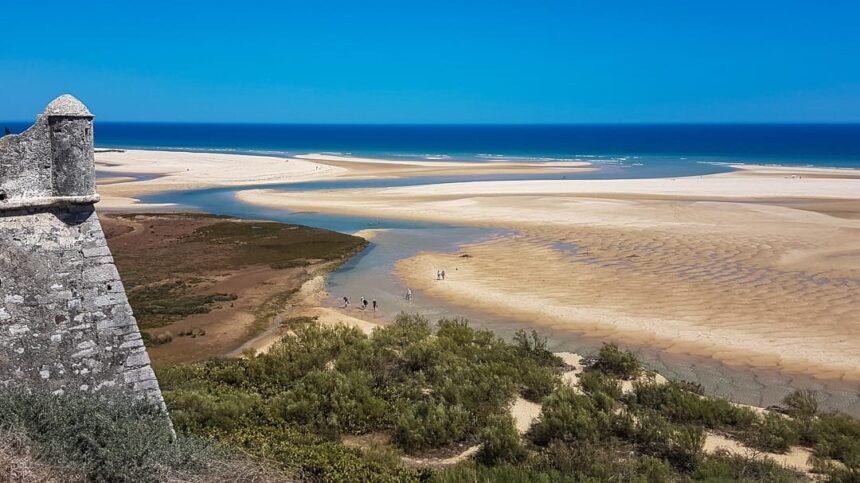
Cacela Velha sits at the far eastern edge of the Ria Formosa, a whitewashed hamlet of perhaps a few dozen houses gathered around a small fort and a single parish church. It marks the point where the lagoon system that runs west toward Faro finally narrows and gives way to the open coast near Manta Rota. Through 2026 it remains one of the least altered coastal settlements in the Algarve, and for visitors arriving from the busier central resorts the contrast is immediate.
Because Cacela Velha falls inside the protected Ria Formosa Natural Park, building is tightly controlled and the village has kept its scale. There are no high-rise blocks and no marina. What draws people is the view from the churchyard wall across the tidal sandbank to the barrier island beyond, reachable on foot at low water or by a short boat crossing from the jetty below.
Where Cacela Velha actually is
It helps to be precise about geography here, because the eastern Algarve confuses first-time visitors. Cacela Velha lies within the municipality of Vila Real de Santo Antonio, close to the resort strip of Manta Rota and a short drive west of Altura. Tavira, the nearest large town, is around fifteen kilometres to the west along the N125. The Spanish border at the Guadiana river is roughly the same distance in the other direction. This is genuinely the eastern end of the Portuguese Algarve, not the central coast that most package holidays reach.
The setting matters for anyone thinking about the area beyond a single visit. The lagoon moderates the light and the temperature, the water is shallow and warm through the summer, and the surrounding farmland still grows the citrus and market vegetables that supply the weekly markets in Vila Real de Santo Antonio and Tavira.
A working landscape, not a resort
Spend a morning in Cacela Velha and the rhythm is agricultural and tidal rather than touristic. Fishermen work the clam and oyster beds on the lagoon flats, a trade that has run here for generations and now supplies restaurants across the eastern Algarve and into Spain. The single row of houses facing the sea holds a handful of small cafes and a seasonal restaurant, and little else. In winter the village all but empties, which is part of its appeal to people who find the central Algarve too developed.
That quietness has consequences for anyone looking at the wider district. Demand for homes across the Sotavento, the local name for this eastern stretch, has firmed steadily as buyers who once looked only at Vilamoura or Lagos discover the calmer coast east of Faro. Anyone comparing options will find that property for sale in algarve portugal spans a wide range here, from restored village cottages inland to modern low-rise apartments along the Altura and Manta Rota beach strip, and the pricing sits well below the golden triangle.
Getting there and getting around
Faro airport is around an hour by car to the west, and the A22 motorway runs parallel to the coast for the whole journey. The regional railway from Faro to Vila Real de Santo Antonio stops at Cacela and at several other eastern towns, and the line has seen investment through 2026 that has improved reliability. Once in the area a car is still useful, since the villages are spread along the coast and up into the hills toward Castro Marim and Odeleite.
Why the eastern edge stays different
The protection that keeps Cacela Velha small is not going to be relaxed, so the village will remain a place to visit rather than a place that grows. What changes instead is the ring of established towns around it. Altura, Manta Rota, Vila Real de Santo Antonio and Castro Marim each offer their own balance of beach access, services and price, and together they make the far eastern Algarve a coherent region rather than a single postcard village. For a traveller who wants to understand the real character of the Sotavento, an afternoon looking west from the Cacela churchyard is the best introduction there is.