



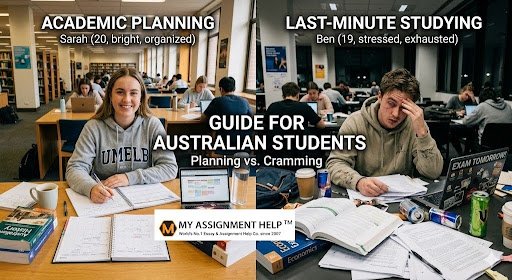
Academic Planning vs. Last-Minute Studying: Guide for Australian Students
The traditional rite of passage for many Australian senior high school and university students involves a familiar, high-stress ritual: the all-nighter. Armed with energy drinks, multi-colored highlighters, and a sudden, crushing sense of urgency, students across the country attempt to cram an entire term’s worth of legal studies precedents, advanced mathematics formulas, or nursing theory frameworks into a single twelve-hour window.
For senior secondary students learning how to maximize ATAR scores and university scholars managing complex modular course loads, understanding why proactive strategy defeats reactive cramming is the first crucial step toward sustained academic excellence.
The Cognitive Science of Learning: Why the All-Nighter Fails
To understand why systematic academic planning reigns supreme, one must first analyze the cognitive science underlying how human brains acquire, store, and retrieve information. Last-minute studying relies almost exclusively on what cognitive psychologists call massed practice. This technique forces massive quantities of disparate information into the short-term working memory simultaneously.
The human working memory has a strictly limited bandwidth. When overloaded during a frantic, late-night cramming session, it experiences acute cognitive overload. While an individual might retain just enough superficial information to recognize terms on a multiple-choice exam the following morning, that knowledge quickly evaporates within 24 to 48 hours.
This psychological phenomenon is best illustrated by the Ebbinghaus Forgetting Curve, which mathematically demonstrates that information acquired without strategic, spaced repetition is lost at an exponential rate. When a student relies on an all-nighter, they are essentially renting the information for a morning, rather than owning it for a lifetime.
Conversely, effective ATAR study habits and university frameworks leverage two of the most robust learning principles in cognitive psychology: distributed practice (spacing study sessions out over extended periods) and interleaving (mixing fundamentally different topics within a single study block).
When an Australian student maps out their assessment calendar six weeks in advance, they consciously allow their brain to transition complex data from short-term working memory into long-term memory architectures. This structural consolidation occurs primarily during deep sleep cycles. It is this neural consolidation that empowers a student to seamlessly apply complex theoretical frameworks to unexpected essay prompts or practical exam scenarios, rather than simply regurgitating memorized, contextless facts.
Structural Shifts in Australian Education: How to Handle Continuous Assessment
The heavy reliance on last-minute studying is a relic of an outdated educational era that was dominated entirely by heavily weighted, end-of-year examinations. Today, the pedagogical design across major Australian institutions has undergone a drastic, permanent shift away from high-stakes final exams and toward consistent, incremental verification of skills.
1. Navigating the Continuous Assessment Model
Whether you are completing your QCE in Queensland, the HSC in New South Wales, the VCE in Victoria, or pursuing an undergraduate degree at an elite Australian university, final grades are rarely determined by a solitary exam block. Instead, comprehensive portfolios, laboratory reports, oral presentations, mid-term tests, and intensive research essays distribute the grading weight evenly across the entire semester or academic year.
A student who relies exclusively on last-minute studying inevitably compromises their continuous assessment scores. An academic essay worth 30% or 40% of a final grade requires weeks of library research, iterative draft revisions, precise peer-reviewed referencing, and logical structural development. It cannot be successfully engineered or faked the night before the deadline. For complex, data-heavy subjects that require extensive spatial analysis and mapping, Myassignmenthelp can help students maintain high standards under tight schedules. Under the continuous assessment model, poor planning in Week 3 directly damages your GPA in Week 12.
2. High-Stakes Milestones and the ATAR Mechanics
For secondary students, the ATAR calculation is aggregate, comparative, and entirely unforgiving. Because school-based assessments—which are moderated against state-wide performance metrics—contribute up to 50% of the final rank in systems like the HSC or VCE, a single poor performance on an early-term assessment due to a lack of preparation can mathematically depress a student’s maximum potential ATAR.
When balancing multiple demanding subjects, students often find themselves overwhelmed by specialized, research-intensive coursework. For instance, juggling field reports and demographic analyses can quickly lead to burnout, making specialized geography assignment help a crucial resource for staying ahead. Consistent, planned, high-quality output is the only viable mechanism available to safeguard a high rank and unlock entry into competitive university courses.
The Strategic Blueprint: How to Construct an Actionable Academic Plan
Transitioning from a reactive crammer to a proactive academic planner requires much more than simply adding deadlines to a digital calendar; it demands the implementation of an evidence-based operational framework. Highly successful students utilize a top-down planning methodology that breaks down an entire academic year into daily, highly manageable, bite-sized actions.
1.Map the Macro Matrix: Week 1 of Semester.
Gather all assignment rubrics, exam dates, and weightings across all units into one master dashboard. Identify “crunch weeks” (typically Weeks 6 and 11).
2.Reverse-Engineer Deadlines: 3-4 Weeks Before Due Date.
Break major 2,500-word assessments into milestones: Week 1 for research, Week 2 for outlining, Week 3 for drafting. Never leave the writing to the final week.
3.Apply Micro-Frameworks: Daily Execution.
Protect your cognitive energy using the Pomodoro Technique (25-minute focus intervals) and test your comprehension using the Feynman Technique to talk through gaps in knowledge.
4.Engage the Feedback Loop: 1-2 Weeks Before Submission.
Submit early drafts to tutors or utilize dedicated external academic support to align your drafts directly with high-distinction marking criteria.
Step 1: Building a Macro Assessment Matrix
At the absolute commencement of each semester or term, compile every single assignment deadline, test date, and presentation schedule into a single, centralized visual dashboard.
- Identify Operational Bottlenecks: Look ahead for “crunch weeks”—typically Weeks 6 and 11 in standard Australian university semesters—where multiple major assessments from different units collide.
- Reverse-Engineer the Deadlines: If a 2,500-word research piece is due in Week 7, create an internal milestone schedule that establishes explicit mini-deadlines. For example: Week 4 must be dedicated to the literature review; Week 5 to drafting the thesis statement and structural outline; and Week 6 to executing the first rough draft.
Step 2: Micro-Planning and Productivity Frameworks
Once the macro targets are firmly set, daily study execution must be governed by proven productivity methodologies rather than emotional whims or levels of motivation.
- The Pomodoro Technique: Break study sessions into high-focus, 25-minute intervals followed by a strict 5-minute mental break. This deliberate pacing prevents decision fatigue and maintains optimal cognitive focus over multi-hour sessions.
- The Feynman Technique: When planning review sessions, do not simply reread notes passively. Attempt to explain the complex concept in plain, simple language to an imaginary audience or a peer. If you stumble or resort to confusing jargon, you have successfully identified a critical gap in your knowledge that needs to be targeted in your next planned study block.
- The Leitner System: A highly organized flashcard method based on spaced repetition. Cards are sorted into various physical or digital boxes based on how well you know the material. This ensures you spend the bulk of your time planning the review of difficult concepts rather than wasting precious hours repeating what you have already mastered.
Real-World Benefits of Planning Over Cramming
The advantages of ditching the all-nighter stretch far beyond merely securing higher grades. Moving toward an intentional framework transforms a student’s mental, professional, and personal well-being.
1. Effective Time Management and Stress Mitigation
The most immediate, noticeable benefit of structured planning is the drastic reduction of academic anxiety. Last-minute cramming triggers a massive surge of stress hormones like cortisol and adrenaline. While these hormones keep you physically awake, chronically high levels of cortisol actively impair the prefrontal cortex—the exact region of the human brain responsible for critical thinking, complex problem-solving, and emotional regulation. By planning ahead, students eliminate the panic cycle, resulting in cleaner, sharper decision-making during timed assessments and significantly better long-term mental health outcomes.
2. The Power of Iterative Feedback
When a student finishes an assignment days or weeks ahead of schedule, they unlock a critical academic superpower: the ability to seek external feedback. In Australian tertiary environments, tutors and lecturers are routinely open to reviewing draft outlines or thesis structures during scheduled office hours. This feedback loop allows students to realign their work precisely with the specific marking rubric before the final submission, effectively turning an average Credit-level piece into a High Distinction asset.
For those demanding moments when institutional feedback is structurally limited, or when complex modular courses require supplementary expert intervention, accessing dedicated external support can bridge the gap. Utilizing comprehensive academic assistance for Australian university guidelines allows students to clarify complex task parameters, refine their formal academic writing style, and ensure their planned output aligns perfectly with rigorous Australian university marking criteria.
3. Preservation of the “Hidden Curriculum” (Soft Skills)
Higher education across Australia is not merely about content acquisition; it is about developing professional competencies. Employers in major business hubs like Sydney, Melbourne, and Brisbane look for graduates who possess exceptional project management, self-regulation, and strategic execution skills. A student who meticulously plans their academic schedule is simultaneously training themselves in the exact project workflow methodologies required in corporate, creative, healthcare, and scientific industries globally.
How to Beat Procrastination When Your Assignment is Weeks Away
If planning is so objectively superior to cramming, why do so many students consistently fall back into the high-stress trap of the all-nighter? Recognizing and mitigating these psychological and behavioral obstacles is vital for long-term adherence to your plan.
Deconstructing the Procrastination Loop and Parkinson’s Law
Parkinson’s Law states that “work expands so as to fill the time available for its completion.” When an Australian university student has a vague, unquantified assignment deadline four weeks away, the lack of immediate urgency often fosters chronic procrastination. The brain struggles to prioritize a distant threat over immediate comfort.
To defeat this loop, academic plans must feature explicit micro-incentives and tightly enforced, artificial constraints. Instead of writing down a vague plan to “work on the history essay on Saturday,” the plan must state an exact micro-task: “Write 300 words analyzing the social impacts of the Eureka Stockade between 10:00 AM and 11:30 AM.” This mental shift moves the focus from an overwhelming, abstract macro-project to an achievable, actionable micro-task.
How to Balance Casual Work and University Study
Australian students face unique lifestyle balancing acts; a remarkably high percentage of domestic undergraduate students balance part-time or casual employment alongside demanding, full-time study loads. Without a strict, visible academic plan, work shifts inevitably cannibalize study time, leading to last-minute emergency extensions or failed units.
An academic plan acts as a vital boundary-setting tool. It explicitly shows a student exactly how many hours they have available for paid work, socializing, exercise, and academic obligations, ensuring they can protect their physical health and social life without ever compromising their hard-earned GPA.
Frequently Asked Questions
Q.1 Is cramming effective for Australian continuous assessment?
No. Unlike traditional systems centered solely on a massive final exam, the continuous assessment model used in Australian high schools and universities grades you on multi-week tasks like portfolios, laboratory reports, and major essays. Because these assignments require deep research, multiple draft iterations, and accurate academic referencing, they cannot be written overnight without severely compromising the quality and losing substantial marks.
Q.2 How can a study plan help maximize my ATAR score?
The ATAR calculation is aggregate and highly competitive. Your school-based assessments throughout the year contribute significantly to your final scaled rank. If a lack of preparation causes a poor performance on even a single early-term assessment, it mathematically depresses your maximum potential ATAR. Consistent, planned academic output is the only way to safeguard your internal ranking.
Q.3 Can last-minute cramming cause long-term academic disadvantages?
Yes. Cramming relies on massed practice, which places information only in your short-term working memory. According to the Ebbinghaus Forgetting Curve, this knowledge drops off exponentially within days. When you advance to higher-level modules or final university exams that require you to synthesize and apply foundational theories, you will find you have retained no core structural knowledge.
Q.4 What is the best way for a busy student to start an academic plan?
Start by creating a Macro Assessment Matrix at the very beginning of the semester. Map out every single assignment, presentation, and exam deadline onto one visible dashboard. Identify your “crunch weeks” (usually Weeks 6 and 11 in Australian university terms) where deadlines overlap, and reverse-engineer your workflow by setting internal mini-deadlines at least three weeks prior.
Summary: A Paradigm Shift for Australian Students
The metrics of modern Australian education leave absolutely no room for the chaos, anxiety, and unpredictable results of last-minute studying. Succeeding at high school and tertiary levels requires treating your academic career less like an unpredictable series of weekly crises and more like a carefully managed enterprise.
By adopting structured macro-calendars, integrating evidence-based cognitive frameworks like spaced repetition, and leveraging elite academic resources when navigating difficult learning hurdles, students can secure higher marks while enjoying a genuinely balanced lifestyle. Stop counting on the frantic, exhausting adrenaline of the all-nighter. Pivot today to an intentional strategy of continuous, planned academic execution, and watch both your performance and your peace of mind transform across the academic year.
About the Author – Drake Miller
I am an experienced academic content writer at Myassignment.services, dedicated to creating informative and student-oriented content for learners across different academic levels. My expertise includes assignment guidance, academic planning, effective research methods, and strategies for improving study performance. By delivering practical insights and easy-to-understand advice, I strive to support students in achieving stronger academic results, staying organized, and managing educational challenges with confidence and greater efficiency throughout their academic journey.