



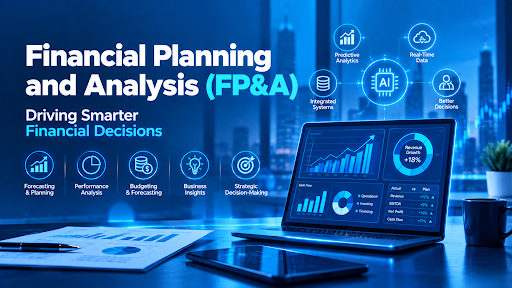
Financial planning and analysis (FP&A) is an essential function that helps organizations connect financial data with business strategy. Modern FP&A teams go beyond budgeting and reporting by using advanced analytics, automation, and artificial intelligence to improve forecasting, manage resources, and support better decision-making.
What Is Financial Planning and Analysis?
Understanding the Role of FP&A
Financial planning and analysis helps organizations plan budgets, forecast performance, analyze financial results, and identify business trends. FP&A teams provide leaders with financial insights that support strategic decisions, resource allocation, performance management, and long-term business growth.
Connecting Finance With Business Strategy
A strong finance strategy connects financial objectives with broader business priorities. FP&A professionals evaluate investments, operating expenses, revenue opportunities, and financial risks to ensure that available resources support organizational goals and create sustainable value.
Improving Financial Planning Processes
Traditional planning processes can require significant manual effort and often rely on disconnected spreadsheets. Modern FP&A uses integrated financial data, standardized processes, and automated reporting to improve planning accuracy, reduce administrative work, and help finance teams respond faster.
How FP&A Supports Better Financial Management
Strengthening Forecasting and Budgeting
FP&A teams use historical performance, current business conditions, and forward-looking assumptions to create realistic budgets and forecasts. Continuous forecasting enables organizations to adjust financial plans as market conditions change instead of relying solely on annual planning cycles.
Supporting Cash Flow Management
Effective cash flow management helps organizations maintain liquidity while meeting operational and strategic requirements. FP&A teams monitor inflows, outflows, working capital, and upcoming financial obligations to identify potential cash pressures and improve short-term and long-term financial stability.
Identifying Cost Reduction Opportunities
FP&A can help organizations identify unnecessary spending, inefficient processes, and areas where resources can be better allocated. Data-driven analysis enables leaders to pursue cost reduction without compromising critical capabilities, service quality, employee productivity, or strategic growth initiatives.
The Role of AI in Finance
Using AI for Financial Forecasting
AI in finance can analyze large volumes of historical and current data to identify patterns that may influence financial performance. AI-supported forecasting can help finance teams improve scenario planning, recognize emerging trends, and make forecasts more responsive to changing conditions.
Automating Financial Analysis
AI can automate repetitive activities such as data classification, variance analysis, reporting, and financial data preparation. By reducing manual work, finance professionals can spend more time interpreting results, evaluating business scenarios, and providing strategic recommendations to business leaders.
Enhancing Scenario Planning
AI-powered scenario planning allows organizations to evaluate different assumptions and potential outcomes more efficiently. Finance teams can model changes in revenue, costs, demand, workforce requirements, or investments to understand potential financial impacts and prepare appropriate responses.
Building a Modern Finance Strategy
Aligning Financial Goals With Business Priorities
An effective finance strategy ensures that financial planning supports the organization’s operational and strategic objectives. FP&A teams can work with business functions to establish measurable targets, allocate resources effectively, and continuously evaluate whether financial performance remains aligned with priorities.
Improving Decision-Making With Data
Reliable financial data gives executives greater visibility into business performance. By combining financial information with operational and market data, FP&A teams can provide broader insights into profitability, resource utilization, customer trends, and opportunities for improving business performance.
Partnering With AI Consulting Experts
Organizations implementing advanced technologies may benefit from AI consulting to identify suitable use cases, assess data and technology readiness, and establish practical implementation priorities. The Hackett Group® can help organizations connect AI opportunities with finance transformation and business objectives.
The Future of FP&A
Moving Toward Continuous Planning
The future of FP&A is increasingly focused on continuous planning rather than fixed annual cycles. Real-time data, automated analysis, and rolling forecasts allow finance teams to update assumptions regularly and provide leadership with more timely information for changing business conditions.
Creating a More Strategic Finance Function
Modern FP&A enables finance professionals to move beyond reporting and become strategic business partners. With stronger analytics, automation, and AI capabilities, finance teams can improve forecasting, support investment decisions, manage financial risks, and contribute directly to sustainable growth.
Conclusion
Financial planning and analysis is evolving from a traditional reporting function into a strategic capability that helps organizations navigate uncertainty and improve financial performance. By strengthening finance strategy, FP&A processes, cash flow management, and cost reduction initiatives, organizations can build greater financial resilience.
The growing use of AI in finance further expands these opportunities by enabling faster analysis, improved forecasting, automation, and scenario planning. Organizations that combine strong financial fundamentals with modern technology and appropriate AI consulting can create a more agile, data-driven finance function prepared to support long-term business growth.