



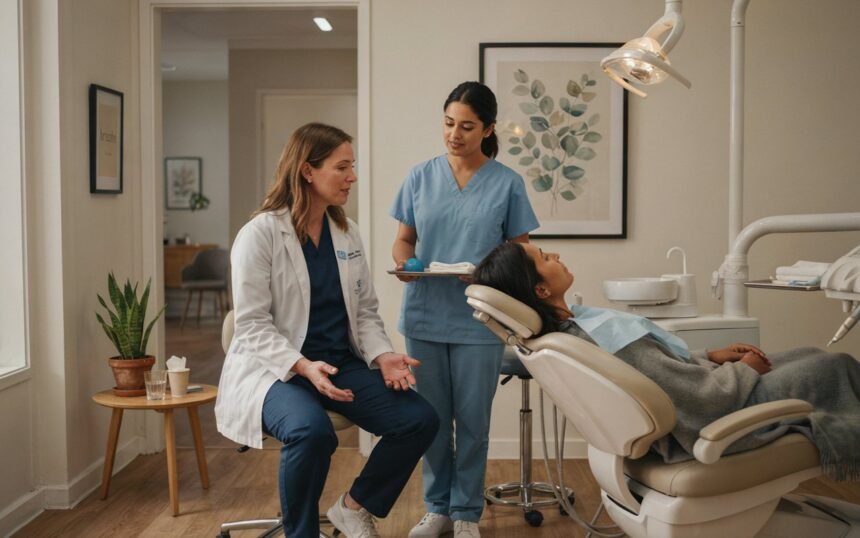
Dental anxiety is a common reason why people delay or avoid dental appointments, yet it is often poorly understood. It is neither a sign of weakness nor something a person can simply dismiss as irrational. For many people, anxiety around dental visits has a real history behind it: a difficult experience in childhood, a procedure that was more uncomfortable than expected, or simply the vulnerability that comes with lying back in a chair while someone works inside your mouth. If any of that sounds familiar, you are in very good company, and the reassuring truth is that modern dental care has changed considerably when it comes to managing anxious patients.
Why Dental Anxiety Deserves to Be Taken Seriously
Anxiety around dental treatment is not a personality flaw. It exists on a spectrum, from mild nervousness before appointments to significant phobia that prevents people from seeking care altogether. At the more severe end, dental anxiety can mean that people put off treatment for years, arriving eventually with problems that have become considerably more complex than they needed to be.
The cycle is a familiar one: anxiety leads to avoidance, avoidance leads to worsening oral health, and worsening oral health creates more complex treatment needs that feel even more anxiety-provoking. Breaking that cycle begins with finding a dentist altrincham patients genuinely trust, a practice where the team understands anxiety, takes it seriously, and has the skills and patience to work with you at your own pace.
What a Supportive Dental Practice Does Differently
Not every dental practice handles anxious patients in the same way. The practices that do it well share certain consistent characteristics that make a measurable difference to how patients feel before, during, and after their appointments.
Before the Appointment
- Offering the opportunity to talk through concerns before the appointment takes place — by phone, email, or at an initial consultation visit where no treatment is performed
- Being transparent about what will happen during the appointment so there are no surprises
- Allowing patients to ask questions without any sense of rush
During Treatment
- Establishing a clear signal, often a raised hand, that means “stop, I need a moment,” and honouring it without question
- Working slowly and explaining each step before doing it
- Checking in regularly rather than assuming comfort
- Using local anaesthetic generously and waiting until it has fully taken effect
After the Appointment
- Acknowledging what was achieved, especially for someone who found getting to the chair a significant accomplishment in itself
- Planning the next appointment with the patient’s comfort in the conversation, not just clinical scheduling
The Role of the Emergency Dentist in Altrincham
For anxious patients, dental emergencies present a particular challenge. When something goes wrong unexpectedly, an acute toothache, a broken tooth, an infection, the urgency of the situation collides with the anxiety that makes dental attendance difficult at the best of times. The result can be paralysis: the patient knows they need help but cannot face seeking it.
This is where access to a compassionate emergency dentist in altrincham becomes genuinely important. An emergency presentation is already stressful without the added layer of feeling unwelcome or rushed. A practice that treats emergency patients with the same patience and sensitivity as routine patients, understanding that an emergency visit may be someone’s first contact with a new dental team, It can significantly influence the outcome of the visit and whether the patient comes back for the follow-up care they require.
Sedation Options for More Anxious Patients
For patients whose anxiety makes standard treatment genuinely difficult to manage, conscious sedation offers a clinically appropriate option that allows treatment to be completed in a much more relaxed state. Inhalation sedation, commonly known as relative analgesia or “happy gas”, involves breathing a mixture of nitrous oxide and oxygen through a small nosepiece, producing a pleasant, relaxed sensation while leaving the patient conscious and able to respond. Intravenous sedation produces a deeper relaxation and may be appropriate for more involved procedures or more severe anxiety, depending on individual clinical assessment. Patients typically have little or no memory of the treatment itself, which many find enormously reassuring. For someone needing an emergency dentist in Altrincham, discussing anxiety and sedation options at the earliest opportunity can help make urgent treatment feel more manageable. Sedation does not replace local anaesthetic; the teeth are still numbed in the usual way, but it can reduce the psychological barrier that makes some patients feel unable to proceed with necessary treatment.
Building Trust Over Time
The most effective management of dental anxiety is not any single intervention; it is the cumulative effect of consistent, patient-centred care delivered over time. A patient who has five good experiences at a dental practice does not have the same anxiety going into the sixth appointment as they did going into the first. This is why continuity of care matters so much for anxious patients. Knowing who you will see, having built a relationship with that person over time, and knowing that they understand your history and concerns makes every subsequent appointment less daunting. Choosing a dentist Altrincham patients can return to regularly can help create this sense of familiarity, trust and reassurance.
Conclusion
Dental anxiety is real, it is common, and it does not have to prevent you from having the healthy smile you deserve. The right dental team, one that listens, that adapts, and that never makes you feel judged for how you feel, genuinely changes the experience. The Good Dentist Altrincham is committed to providing exactly this kind of patient-centred care, ensuring that every patient, regardless of how they feel about dental visits, is met with patience, understanding, and the clinical skill to make treatment as comfortable as it can possibly be.