



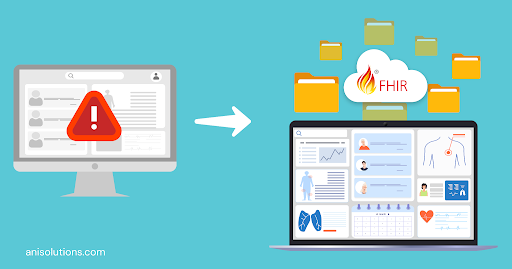
Before the FHIR R4 or FHIR APIs, HL7 v2 made it possible to share patient records and helped clinicians make informed decisions. However, despite it being a much better option than HL7 or HL7 v3, it can’t keep up with the rapidly changing healthcare landscape.
The modern healthcare needs a real-time and faster way to exchange information, and that’s why it is important to move beyond systems using only HL7 v2. If you want to have a quick way to exchange patient data and keep it meaningful, then adopting FHIR APIs is the best option.
But replacing HL7 v2 is not practically possible as nearly every healthcare provider uses legacy systems, and that’s where the healthcare data migration interface engine comes into the picture. This engine acts as a bridge between modern and legacy systems and keeps data integrity while improving data exchange and interoperability in healthcare organizations.
However, switching systems is not that easy, and that’s why in this blog, we will break down how to migrate from the legacy HL7 interface engine and rigid point-to-point integration, along with the benefits of modern healthcare integration platforms.
Signs Your Interface Engine Is Holding You Back
While it may sound like the legacy systems suddenly collapse and stop sharing data if you observe it from outside or on the surface, it is not the truth. These systems always show signs and slowly stop supporting the smooth data exchange.
You might have noticed some delays, frequent failures, or a need to constantly work around to get the patient data you want. And these are the first signs that your interface engine is holding your practice back.
If your staff notices these signals early in the collapse, then the damage can be controlled much more easily and efficiently. However, with most of the clients, that is never the case, and they notice it too late.
The result is expensive maintenance and a system that is put together and held by custom codes, increasing the complexity of integration. Additionally, when data is not moving smoothly across the clinic, or your entire care network visibility drops, and care becomes reactive, decreasing performance and leading to loss of care opportunities.
But the biggest challenge comes with compliance and regulations, such as HIPAA require data security, interoperability, and privacy. That’s why it is important to recognize that legacy systems are holding your practice back and address them as early as possible.
What a Modern Integration Platform Looks Like?
A modern healthcare integration platform isn’t just an upgrade—it’s built for how healthcare actually operates today: fast, connected, and constantly evolving.
Here’s what that looks like in practice:
- Hybrid support for legacy and modern standards: Supports both HL7 v2 messaging and FHIR APIs in one place. This allows organizations to modernize gradually without disrupting existing systems.
- Cloud-based scalability: Built on cloud infrastructure that scales with demand. No need to overprovision or worry about system slowdowns during peak data loads or API spikes.
- Unified data models: Instead of creating custom mappings for every connection, data is normalized once and reused across systems. This reduces complexity and keeps data consistent across the ecosystem.
- Low-code and configuration-driven tools: Integration teams can update workflows, mappings, and endpoints without heavy development cycles. Changes that used to take weeks can now be done in hours.
- Improved visibility and monitoring: Real-time dashboards and alerts provide clear insight into data flow, errors, and system performance—making it easier to detect and fix issues early.
- Built for real-time data exchange: Supports event-driven workflows and real-time processing, enabling faster clinical decisions and more responsive systems.
How to Migrate from Legacy to Modern Systems?
Migrating from a legacy system isn’t just a technical upgrade—it’s a careful transition that needs to protect data, workflows, and day-to-day operations.
Here’s what a structured approach looks like:
- Start with a full interface audit: Identify every active integration—what systems it connects, what data it handles, and how critical it is. Most organizations uncover redundant or outdated interfaces that can be removed, reducing complexity before migration even begins.
- Eliminate what you don’t need: Legacy environments often carry unused or duplicate integrations. Cleaning these up early makes the migration faster, cheaper, and easier to manage.
- Adopt a phased or parallel migration approach: Instead of replacing everything at once, move interfaces gradually. Running legacy and modern systems in parallel during the transition helps avoid disruptions and ensures continuity of care.
- Prioritize high-impact integrations first: Focus on interfaces that directly affect clinical workflows or patient data. Stabilizing these early builds confidence and reduces operational risk.
- Test and validate data thoroughly: Every interface needs end-to-end validation. Data leaving the source system should match exactly what reaches the destination, including edge cases like formatting, codes, and exceptions.
- Use a modern integration platform to handle transformation: Modern tools simplify mapping, standardization, and validation—helping maintain data integrity without heavy manual effort.
- Monitor closely after transition: Even after go-live, continuous monitoring is critical. Early detection of errors or inconsistencies helps prevent downstream issues and ensures a smooth stabilization phase.
Managing Data Transformation & Standardization?
Modern integration isn’t just about moving data—it’s about making sure that data actually means the same thing everywhere it goes.
Here’s how that plays out in practice:
- Standardizing clinical data using common terminologies: Converting data into widely accepted standards like LOINC and SNOMED CT ensures consistency across systems. Lab results, diagnoses, and clinical observations become easier to interpret and share.
- Reducing reliance on one-off mappings: Legacy systems often depend on custom mappings for every integration. Modern platforms reduce this by normalizing data into a common structure, cutting down complexity and long-term maintenance.
- Improving data quality at the source: Transformation layers can clean, validate, and standardize data as it moves between systems—reducing errors, inconsistencies, and missing information.
- Enabling better analytics and reporting: Standardized data makes it easier to generate accurate reports, run population health programs, and feed analytics platforms or AI models with reliable inputs.
- Supporting interoperability across vendors: When data follows consistent standards, connecting new systems becomes simpler. Integrations are faster, and there’s less need for custom work every time a new vendor is introduced.
Challenges in Interface Engine Modernization
Modernizing your integration layer sounds great on paper, but in practice, it comes with real challenges that can’t be ignored.
- Managing downtime and operational risk: Healthcare systems run 24/7. Any disruption to data flow—whether it’s orders, lab results, or patient updates—can impact care delivery. Even small migration issues can have outsized consequences, which makes planning and execution critical.
- Untangling complex legacy dependencies: Over time, legacy interface engines evolve into tightly connected systems with hidden dependencies. Custom scripts, edge-case logic, and undocumented workflows make migration more complicated than it initially appears.
- Balancing resources and timelines: The same teams responsible for maintaining existing integrations are often expected to lead modernization efforts. Without proper planning, this creates bandwidth issues and slows progress on both fronts.
- Managing cost pressures: Modernization requires upfront investment—in technology, time, and expertise. While the long-term ROI is strong, the initial cost can be a barrier if not clearly planned and justified.
- Adapting teams to new tools and workflows: Moving to modern platforms means shifting how teams work. Learning new tools, processes, and integration approaches takes time, and adoption doesn’t happen overnight.
Preparing for the Future of Healthcare Integration
Modernization isn’t just about fixing today’s limitations—it’s about building an integration layer that can keep up with what healthcare is becoming.
Here’s where things are heading:
- Shift toward real-time, event-driven data exchange: Instead of relying on batch processing or periodic updates, systems are moving toward event-driven models. Actions like patient admissions, lab results, or medication updates trigger instant data flow across systems—keeping everyone aligned in real time.
- Stronger support for AI and advanced analytics: AI-driven care, predictive modeling, and clinical decision support all depend on timely, structured data. Modern integration platforms make that possible by delivering clean, consistent data exactly when it’s needed.
- Expansion of digital health ecosystems: From patient-facing apps to remote monitoring tools, healthcare is becoming more connected. Integration platforms need to support a growing network of systems, not just a fixed set of internal applications.
- Greater reliance on interoperability standards: Standards like FHIR continue to shape how systems communicate. Platforms that are built around these standards are better positioned to adapt as requirements evolve.
- A foundation for continuous innovation: Instead of rebuilding integrations every time a new tool or technology is introduced, modern platforms provide a flexible base that supports ongoing change—whether it’s new care models, technologies, or regulatory demands.
Conclusion: From Middleware to Modern Integration
In a nutshell, with rapidly advancing technology and the need for faster, real-time data exchange, legacy systems can’t support the modern healthcare landscape effortlessly. They need to be modernized to keep up with the changing landscape.
This is where FHIR integration and interface engine modernization come into the picture. They help adopt systems to evolving healthcare without disrupting the existing systems and workflows.
So, if you are using a legacy system, then it is time to shift to a more effective and efficient solution without fearing downtime or disruption. Talk to our integration experts and book your demo right away for better clarification.
FAQs
- What is a healthcare interface engine?
A healthcare interface engine is middleware that connects systems like EHRs, labs, and billing platforms, enabling data exchange using standards like HL7. It routes, transforms, and manages clinical data across systems to ensure interoperability.
- Why are legacy HL7 interface engines becoming outdated?
Legacy HL7 engines rely on rigid, point-to-point integrations, making them hard to scale, maintain, or adapt. They struggle with real-time data exchange, modern APIs, and cloud-native environments, limiting agility in today’s interoperability-driven healthcare landscape.
- What is healthcare data migration interface engine modernization?
It refers to upgrading outdated interface engines while migrating existing integrations and data workflows to modern platforms. This ensures continuity while enabling better scalability, real-time processing, API support, and compliance with newer interoperability standards.
- How can organizations migrate from legacy interface engines?
Organizations typically audit existing interfaces, prioritize critical workflows, adopt modern integration platforms, and migrate in phases. Using APIs, FHIR standards, and middleware abstraction helps reduce disruption while ensuring backward compatibility during transition.
- What are the benefits of modern integration platforms?
Modern platforms offer scalability, real-time data exchange, API-first architecture, improved security, easier maintenance, and cloud compatibility. They reduce integration complexity, enhance interoperability, and support advanced use cases like analytics, automation, and patient-centered care delivery.
- What challenges are involved in interface engine modernization?
Challenges include data mapping complexities, downtime risks, legacy system dependencies, regulatory compliance, and skill gaps. Organizations must carefully plan migration, ensure data integrity, and manage change without disrupting ongoing clinical and operational workflows.
- How do FHIR and APIs improve healthcare integration?
FHIR and APIs enable standardized, real-time data exchange across systems. They simplify integration, reduce dependency on custom interfaces, support mobile and cloud applications, and make healthcare data more accessible, improving interoperability and innovation.
- What is the future of healthcare interoperability?
The future is API-driven, cloud-based, and patient-centric. Interoperability will focus on seamless data exchange, AI-driven insights, and ecosystem connectivity, powered by standards like FHIR, enabling better care coordination, value-based care, and digital health innovation.